
Understanding Mechanisms of Adaptive Intelligence & Agency
Across neural circuits, behavior, mind, and systems.
NAIADEL investigates the computational and neural mechanisms of adaptive intelligence and agency: how systems regulate their own learning, restructure control, and maintain purposeful behavior under changing conditions. We combine computational modeling, behavioral experiments, EEG, clinical research, and artificial-agent systems.
How do humans and AI agents decide when to persist, explore, or change course — and why do these mechanisms sometimes break down?
What we mean by adaptive intelligence and agency
Adaptive intelligence is the capacity to adjust how a system learns, decides, and exercises control as conditions change.
Our integrative framework for adaptive intelligence and agency.
Rather than treating adaptive intelligence and agency as unitary capacities, NAIADEL dissects the interacting mechanisms often grouped under “control” (from learning and inference to meta-control and meta-learning) across timescales, development, maladaptation, and systems.
At NAIADEL, we build a mechanistic science of adaptive intelligence and agency with translational reach into mental health, human productivity, and the design of agentic artificial systems and adaptive environments. Rather than studying human maladaptation and artificial adaptation separately, we use shared computational principles and experimental tools to understand, perturb, and build adaptive agency across biological and artificial systems.
Building Mechanistic Theory
We use theory not merely as a conceptual narrative, but as an explicit account of the variables, processes, and relationships that generate testable and falsifiable predictions. By mechanisms, we mean organized processes that explain how adaptive behavior emerges, is regulated, and changes, and that can be distinguished from competing explanations through measurement, modeling, and perturbation.
Sustain & Restore Agency
Use mechanistic insights to support adaptive ways of exercising control: when to act, persist, share, delegate, or let go as circumstances change.
Explain & Address Maladaptation
Trace how differences in learning, inference, and meta-control lead to distinct patterns of maladaptation within and across psychopathologies. Use mechanistic adaptability profiles to tailor interventions.
Design & Support Agency-Based AI
Create artificial agents and adaptive environments that support human learning and adaptation without displacing people’s capacity to decide and exercise control.
Together, these themes trace how systems learn what actions matter, regulate when and how to exercise control, become maladaptively organized, and interact with artificial systems that instantiate and reshape these processes.
Learning What Actions Matter
How do systems learn and reason about which actions, agents, and environmental forces produce outcomes; and how do they assign credit when control is uncertain or changing?
We study how systems reason about who or what made a difference, assign credit for outcomes, and update where control is understood to reside.
Concrete ExampleA student's grade goes up: was it the new study method, an easier exam, or luck? What they credit determines what they do next.
Regulating When and How to Act
How do inferred control, stress, and volatility guide persistence, exploration, disengagement, and decisions to exert, share, delegate, or relinquish control?
We examine how meta-control organizes not only which action to take, but how control itself is allocated and reconfigured as conditions change.
Concrete ExampleA founder weighing whether to keep pushing a struggling product, hand it to a cofounder, or shut it down.
When Adaptation Becomes Maladaptive
How do alterations in learning, credit assignment, and meta-control produce distinct patterns of meta-learning and maladaptation within and across psychopathologies?
We trace how normally adaptive processes become miscalibrated, rigid, or mismatched to context, producing different forms of maladaptation across people and conditions.
Concrete ExampleTwo people both procrastinate but one misjudges how much effort will actually help, while the other expects to fail no matter what.
Artificial Systems and Co-adaptation
How can artificial agents serve as model systems for adaptive intelligence; and how do humans and AI systems reshape one another’s learning, control, and agency over time?
By building agents whose learning and control architectures can be manipulated, we test mechanisms by construction and examine when AI supports, or displaces, human agency.
Concrete ExampleA clinician comes to lean on an AI triage tool: does it sharpen their judgment over time, or quietly erode it?
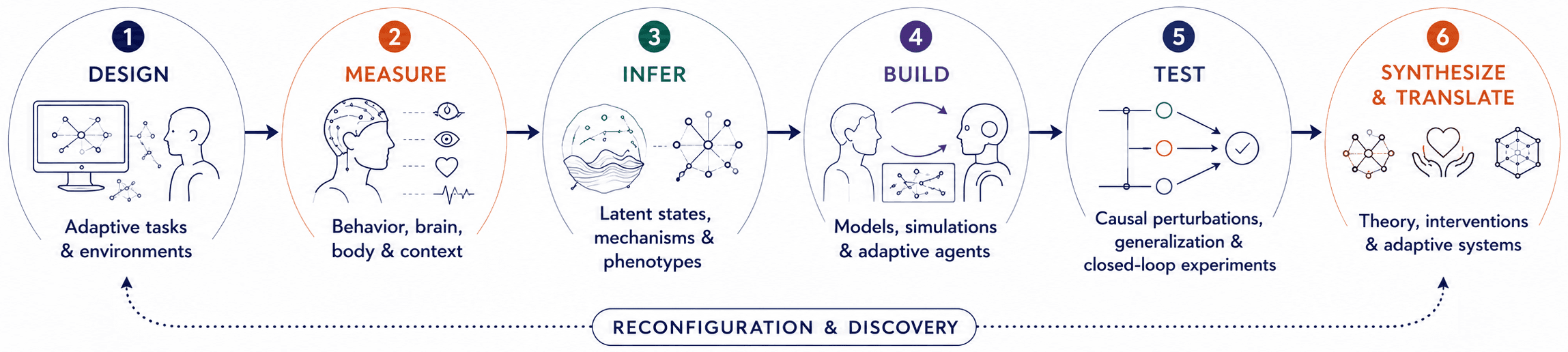
We combine adaptive experiments with measurements of behavior, brain, body, and context to infer latent processes such as learning, uncertainty estimation, effort allocation, and controllability inference. We formalize these mechanisms in computational models, simulations, and adaptive artificial agents, then test them through causal perturbations and generalization before synthesizing them into theory, interventions, and adaptive systems.
Empirical & Multimodal
Behavioral experiments · EEG recording · Eye-tracking · Physiological measures · Clinical assessment · Large-scale online datasets
Computational Methods
Drift Diffusion Models · Reinforcement Learning · Hierarchical Bayesian Models · Meta-learning architectures · Digital phenotyping · LLM-based analysis
Datasets
Large-scale behavioral datasets (cognitive flexibility, controllability, decision-making) · Multimodal (EEG + behavior + clinical) · Longitudinal digital phenotyping
We do not use AI only to analyze data or develop applications. We build and study artificial agents as experimental model systems for adaptive intelligence. By manipulating their learning architectures, environmental structure, and opportunities for control, we can test mechanistic hypotheses that are difficult to isolate in biological systems. Insights from human behavior and neuroscience inform artificial systems, while artificial systems generate new hypotheses about human adaptability and agency.

These interconnected lines of research examine adaptive intelligence and agency across behavioral, computational, neural, clinical, longitudinal, and artificial systems. Each brings together formal theory, adaptive experiments, quantitative modeling, and targeted measurement or perturbation.
Controllability, Persistence & Escape Under Threat
We study how people learn whether their actions can change outcomes, and how threat and uncertainty shape decisions to persist, explore, or disengage. Adaptive experiments and computational models allow us to distinguish the control that is available from how control is inferred and used to guide behavior.
Behavioral and computational mechanismsNeural Dynamics of Meta-Control & Cognitive Flexibility
We investigate how neural systems track changing demands, arbitrate between persistence and switching, and reorganize control as conditions change. By combining computational models with EEG, eyetracking and other multimodal neuroscience, we link latent learning and decision processes to neural dynamics across timescales.
Neural implementationComputational Psychiatry of Maladaptive Agency
We examine how differences in learning, inference, and meta-control produce distinct patterns of maladaptation within and across psychopathologies. Mechanism-based profiles help explain how similar symptoms can arise from different processes, and how related processes can cut across diagnostic categories.
Psychopathology & Individual DifferencesLearning to Adapt Across Time and Context
Through game-based experiments, ecological momentary assessment, and longitudinal measurement, we study how people adapt not only what they do and believe, but also how they learn, infer control, and organize action as situations change. This reveals person-specific dynamics of adaptation and agency across timescales.
Meta-learning and ecological dynamicsHuman–AI Co-adaptation & Agency-Supportive Systems
We study how repeated interaction with artificial agents reshapes human learning, confidence, delegation, and the exercise of control, while human behavior simultaneously shapes artificial systems. This work informs adaptive systems that support judgment and agency rather than simply replacing them.
Agentic AI systems