
Assessing and Building Adaptive Intelligence & Agency Through
Gearshift Fellowship
A dynamic, game-based environment & evolving scientific ecosystem.
Gearshift Fellowship (GF) combines a modular, game-based research platform with an evolving scientific ecosystem. The platform provides a unified architecture for studying processes that are often examined separately (such as reinforcement learning, cognitive control, motivation, affect, and social interaction) within dynamic, adaptive contexts.
The fellowship is the community of people, exchanges, and project-specific relationships growing around this infrastructure. It creates opportunities for researchers, clinicians, engineers, students, and partners to exchange ideas, participate in scientific conversations, and explore collaborations aligned with their goals.
NAIADEL uses the GF platform to study adaptive intelligence and agency and contributes to its broader development through research, scientific exchange, and community-building. GF itself is being developed as a broader scientific and innovation platform that can support diverse research questions, applications, partnerships, and translational pathways.
Connecting platform, science, community, and impact.
The goal is to build and translate shared knowledge about adaptive intelligence and agency into theories, models, tools, interventions, and education.
Engaging with the Fellowship
We welcome inquiries from researchers, engineers, clinicians, educators, institutions, and others who share our commitment to rigorous, responsible, and cumulative science. Whether you are interested in exploring GF for a research project, contributing expertise or ideas, or helping develop a Fellowship grounded in shared purpose, we would be glad to hear from you. Because pathways for participation are still evolving, opportunities are considered individually.
Pathways to join →Gearshift Fellowship brings together three interconnected layers: a dynamic environment for experimentation, the Supertask framework for studying adaptation across contexts and time, and a distributed fellowship through which research, modeling, and collaboration can grow.
A dynamic game-based platform
A modular, dynamic environment where people and artificial agents encounter changing goals, contingencies, costs, and social situations. Different game missions can be embedded in the same evolving world designed for analyses with computational models that are rooted in cognitive psychology and neuroscience.
Watch the video of one GF application →A supertask approach
A shared experimental framework that connects concepts (e.g., cognitive control, reinforcement learning, effort, avoidance) typically studied in isolation. This hierarchical architecture allows us to dissect cognitive and affective mechanisms and higher-order processes that operate at different timescales across cognitive and social contexts.
See the paper →A Fellowship of Shared Purpose
A community of researchers, clinicians, engineers, students, educators, and partners who bring different forms of expertise to a shared purpose: understanding how learning, control, motivation, social interaction, and related processes operate together in dynamic environments. The Fellowship is grounded in curiosity, trust, intellectual generosity, perseverance, and mutual responsibility. People may engage through scientific exchange, shared learning, events, or project-specific collaborations. Participation does not by itself imply platform access, contribution of research materials, or a formal partnership.
Learn more about participation →Together, we build the infrastructure and insights for integrative research to understand human and artificial behavior holistically.
Human adaptation rarely depends on a single mechanism. Learning, control, motivation, affect, and social inference interact as conditions change. Yet these processes are often studied in separate tasks, datasets, and disciplines.
The Gearshift Fellowship platform provides a shared, modular environment in which these mechanisms can be experimentally manipulated, computationally modeled, and studied in relation to one another as behavior unfolds.
The goal is not merely to determine whether someone succeeds, but to understand how humans and artificial agents infer what is controllable, reorganize their behavior, and transfer learning across contexts.
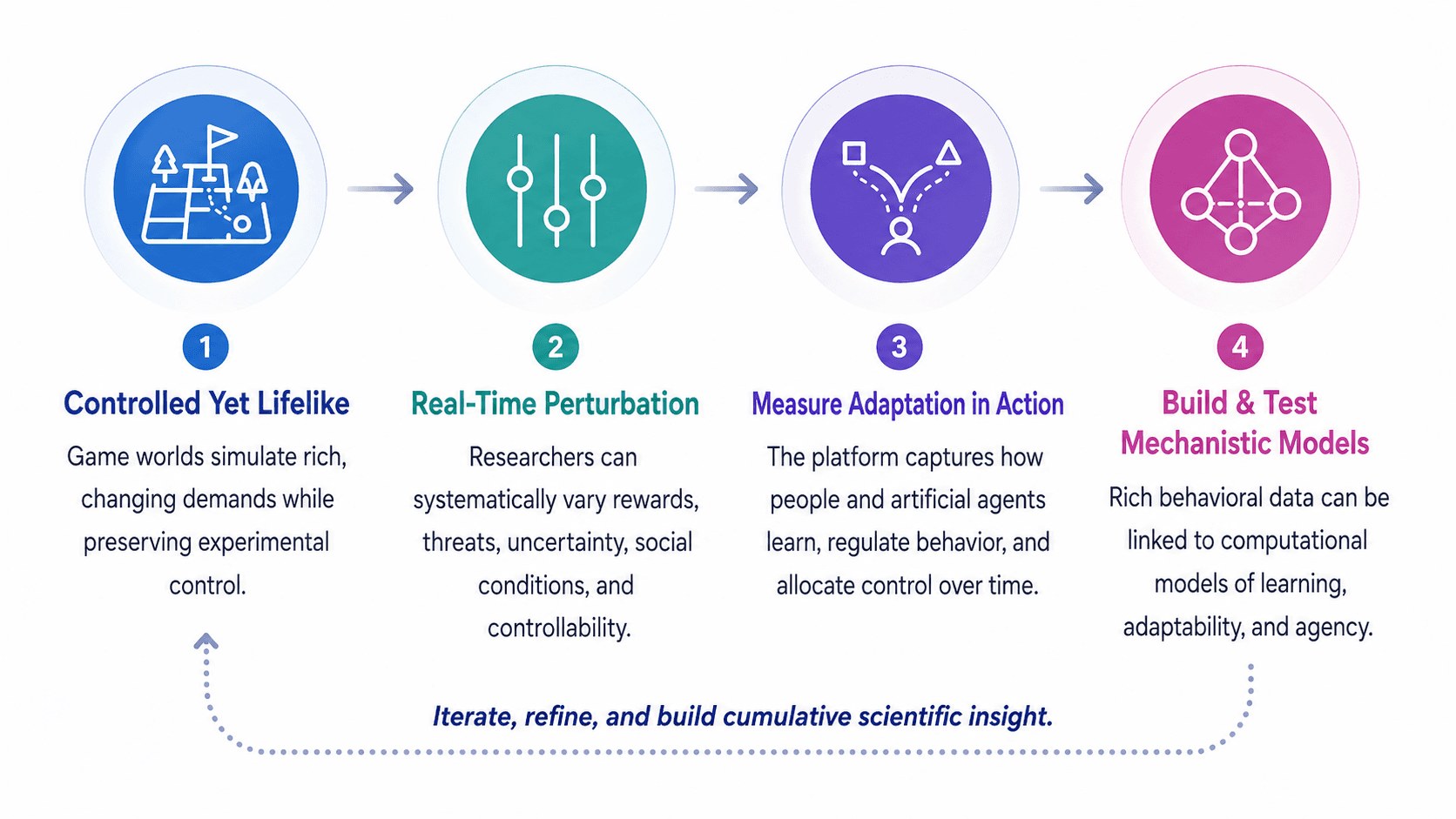
Reconfigurable Game-Based Missions
Experimental contingencies, goals, costs, uncertainty, and social conditions can be systematically varied within a common game environment.
Cross-Mission Measurement
Behavior can be linked across trials, blocks, missions, and repeated sessions to study adaptation across contexts and timescales.
Computational Integration
Experimental variables and behavioral responses can be connected to reinforcement-learning, decision-process, hierarchical, and agent-based models.
Human and Artificial Agents
The environment is being developed to support comparable challenges for human participants and artificial agents, enabling research on adaptation and human–AI interaction.
Beyond separate tasks toward a unified science of adaptation.
Conventional task batteries place separate tasks side by side and typically analyze them independently. A Supertask instead embeds distinct but structurally related missions within one continuous, goal-directed game world.
Across missions, the core interaction structure remains consistent while goals, contingencies, framing, and cognitive or social demands change. This makes it possible to study how adaptation unfolds within particular challenges, transfers across contexts, and develops over time within a shared computational framework.
Shared Core, Changing Contexts
A consistent game structure connects missions while goals, contingencies, uncertainty, and demands are systematically reconfigured.
Goal-Directed Continuity
Interdependent decisions accumulate toward evolving goals, and earlier choices and experiences shape what happens next.
Nested Across Scales
Behavior unfolds across trials, blocks, missions, and longer-term trajectories, linking momentary decisions with broader adaptive patterns.
Unified Computational Modeling
Shared structure allows mission-specific responses, general adaptive strategies, and changes over time to be modeled together.
Within the broader Gearshift Fellowship ecosystem, NAIADEL serves as a scientific home for foundational research conducted using the Gearshift Fellowship platform. We develop and validate theories, experimental missions, computational models, and measurement frameworks to explain how adaptive intelligence and agency emerge, change, and break down.
Connecting Mechanisms Across Game Missions:
Learning & Structure Inference
How humans and artificial agents infer changing rules, discover task structure, and transfer learning across missions.
Control Allocation & Flexibility
How agents reorganize attention, effort, and strategy as goals, demands, and opportunities change.
Persistence, Disengagement & Controllability
How agents infer when actions matter and decide whether to persist, switch strategy, seek support, delegate, or let go.
Social Adaptation & Human–AI Interaction
How trust, cooperation, delegation, and artificial partners shape behavior and the allocation of control.
Cross-Mission Phenotyping
How patterns across missions and time reveal individual differences, adaptive strategies, and mechanisms of maladaptation.
Adaptive Training & Support
How insights from behavior and computational models can inform personalized feedback, learning environments, and future interventions.
Gearshift Fellowship is being developed not only as research infrastructure, but also as a setting for scientific exchange, learning, community, and project-specific collaboration. These forms of engagement are distinct: participating in a talk, discussion, or community does not by itself imply platform access, contribution of research materials, or involvement in a formal project.
The long-term aim is to reduce duplicated infrastructure across individual projects and create a common environment in which findings can accumulate, mechanisms can be compared, and new scientific collaborations and translational applications can emerge.
Gearshift Spotlight Series
Conversations on adaptive intelligence, agency, and neurocomputation. Join invited talks and discussions with researchers and practitioners working across human and artificial adaptability, computational modeling, mental health, and related fields.
Get invitations & reminders →Gearshift Fellowship Community
Join the GF Discord to exchange ideas, share resources, discuss ongoing work, and connect with researchers, students, builders, clinicians, and partners across disciplines.
Join the Discord community →Gearshift Fellowship Updates & Opportunities
Subscribe to the Gearshift Fellowship newsletter for updates on research, platform development, events, workshops, participation opportunities, and new ways to become involved.
Subscribe to the newsletter →Collaborate with Gearshift Fellowship
Researchers, institutions and prospective partners interested in developing missions, testing computational models, contributing analyses or datasets, studying human–AI adaptation, or exploring translational applications or other type of partnerships are invited to connect.
Discuss a collaboration →